Papa Rouyo in 2024: the heart cane
Need help ? 01 85 41 11 20
|
Book for punchs & rhums arrangés All the recipes for sparkling, fruity, and surprising punches and arranged rums, not forgetting the great classics. |
|
|
Caroni 10th Anniversary We are pleased to present one of the centerpieces of our 10th years anniversary collection... |
|
Flat Peach Brandy (Pesche Saturno) made by one of the best distillers in the world: Capovilla |
|
We offer 4 rum workshops from €50, discover our many dates. Possibility of privatizing a workshop. Our workshops are mainly in French. |
Come to the store to discover the terroirs of rum, new references - Our tastings are 100% free |
Compose your sample box (60ml sample) with our box of 2, 3 and 5 samples. Your personalized gift! |
Papa Rouyo is the story of planters who each year were not sure to see their canes harvested by the Guadeloupe sugar factory, Usine Gardel. Not sure because located on the margins of the harvested lands, not sure because the plots were considered small, not sure because it depended on the needs of the Factory. The situation became complicated. A collective of planters wished then to produce agricultural rum in order to save the cane they inherited. The project was born in 2014 and the first rums docked on the hexagonal coasts in 2021.
Papa Rouyo is also the nickname of Joris Galli’s great-grandfather, one of the founders of this rum, alongside Tim Synesius and Jean-Marie Gobardhan. His lands are still cultivated today to produce Papa Rouyo rum.
Papa Rouyo is finally a family of cane planters. There was Papa Rouyo, his real name Charles Albert Ruscade, but also his wife Agathe. And most importantly there was the daughter, Danièle, who also fought to keep the culture of cane in the family.
In Papa Rouyo's time, the family had a so-called sharecropping contract. In other words, the lands leased at the time had to contractually be dedicated to the cultivation of sugar cane. In the 1970s and 1980s, an urban planning project aimed to transform these agricultural lands into real estate construction. The planters then felt close to expulsion. Danièle fought for 17 long years to be able to buy back Papa Rouyo's lands.
Today sugar cane is part of the family's heritage. And for Joris Galli, it must remain so.
Parmi les cuvées récentes nous vous proposons un focus sur l’Oeilleton et le Génération.
It is a white rum that is 51% alcohol by volume, distilled in a pot still. We are looking at a blend of a red cane distillate of 30% and a white cane distillate of 70%. These proportions of varieties are reversed in the white rum Le Rejeton. The name œilleton is an agronomic term. At the nodes of the sugar cane, a small oval shape called an eye is observed. This eye can turn into a bud. It is then called an œilleton. If the œilleton grows to become a cane, it is called a sucker. The œilleton constitutes one of the stages of cane growth.
The white cane is called Matos cane in the North of Grande-Terre where the plantations are located. It is a fleshy cane that requires little water, perfectly adapted to the climate of Grande Terre. It grows quickly in four months before stopping its growth. Its maturation then goes through an expansion. It is a very rich and very sweet cane.
The rum Vwayaj’ is, for example, produced solely from white cane.
We are on the last rum for which Papa Rouyo only took care of the aging in barrel. Three types of barrel, with different toastings, were used for this aging: new French barrel, new American barrel, ex-Cognac barrel. Blindly, one would give a much older age to this three-year-old rum.
The next cuvée Jénérasyon, which will be released at the end of next year, will have been distilled in Papa Rouyo's two stills.
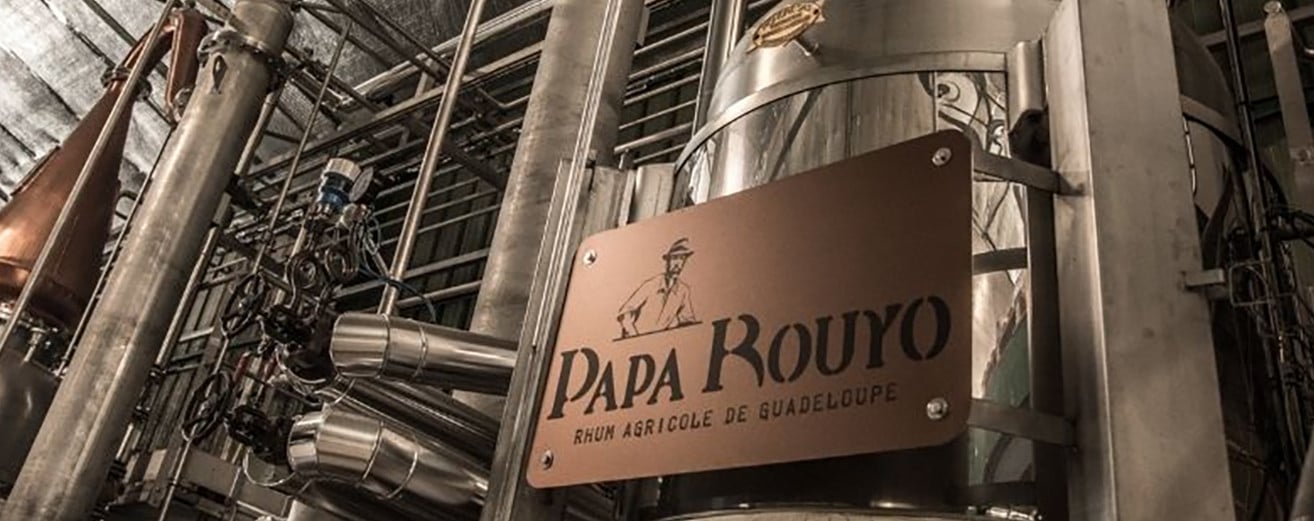
At Papa Rouyo, there are two stills, a Wash Still, named Agathe, and a Spirit Still, named Danièle.
The Wash Still allows to remove impurities and eliminate the heads and tails. The level of these depends on the type of cane. The heart is then kept, which then has an alcohol content of 30-35%. The heads and tails are redistilled in the Wash Still.
The heart is then redistilled in the Spirit Still. The heads and tails are separated again and are redistilled in the Wash Still. The heart of the Spirit Still produces a finer rum that is kept for bottling or barreling. It has an alcohol content between 65 and 68% when coming out of the still.
For the future Papa Rouyo has in store a single cask rum Eritaj, produced in 651 bottles. It is a rum aged-under-wood for 18 months that is arriving very soon. In 2024, a Single Planter edition will also be released. This cuvée of white rum will come from the work of a Cane Master on a specific terroir. Tim Synesius will be at the helm.